.svg)

TL;DR
A titanium supply disruption hits Véracier Industries.
Procurement wants to know whether supplier penalties can be suspended. Operations wants to know whether production delays are contractually protected. Finance wants an exposure estimate before the executive committee meeting. Legal wants to avoid making a statement that becomes indefensible the second outside counsel reads the contracts carefully.
At first glance, the task sounds easy. Find the force majeure clauses. Check whether supply-chain disruption is covered. Done.
Except enterprise contracts are never that clean.
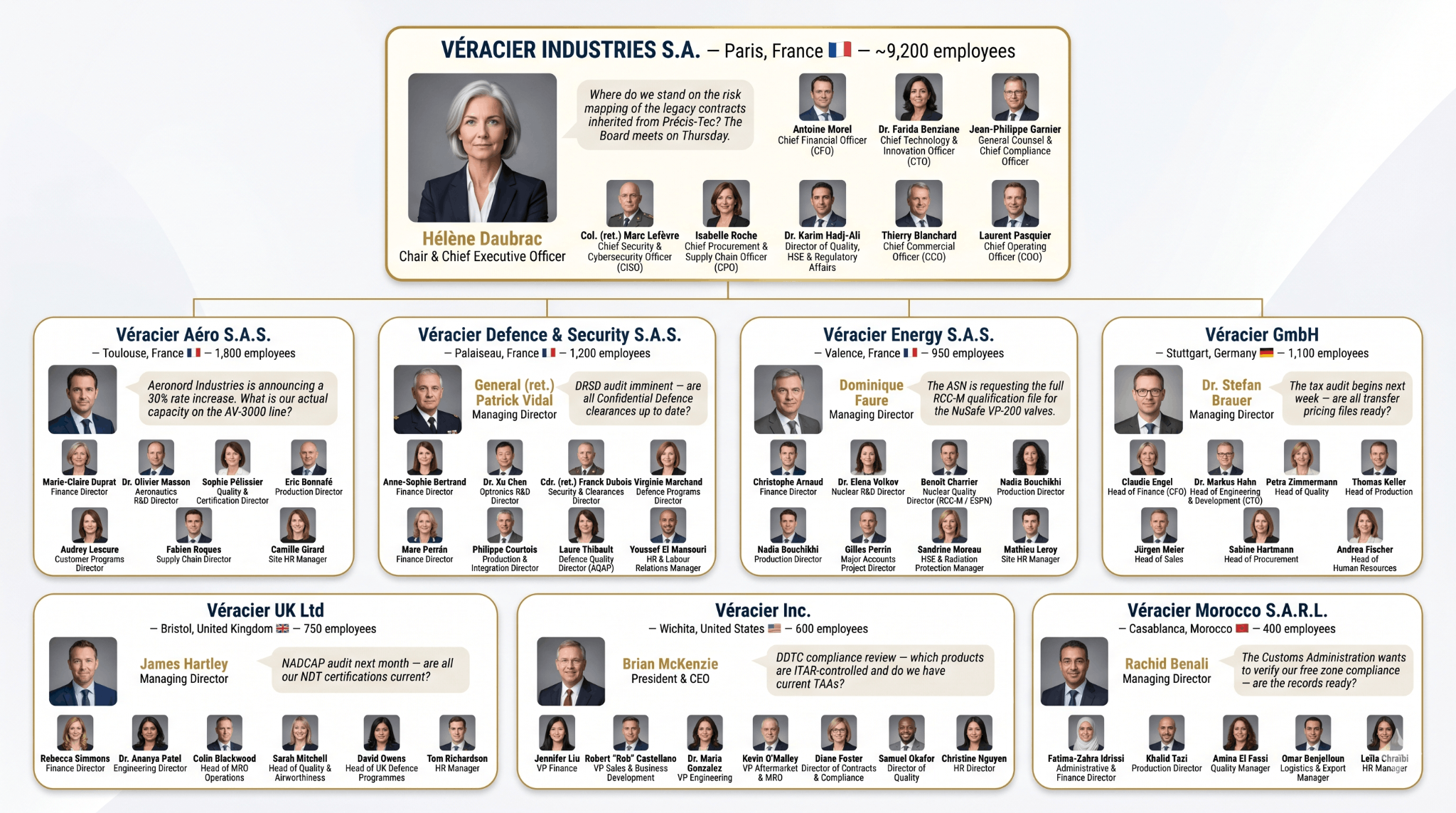
It means nineteen supplier agreements across France, Germany, Italy, Spain, and the UK. It means reading clauses drafted in French, German, Italian, Spanish, and English, under three legal systems, each with its own doctrine of what counts as an event beyond control. It means cross-checking masters, annexes, amendments, and side letters that nobody has consolidated in three years.
Some agreements use the term force majeure. German suppliers refer to Höhere Gewalt. One English contract describes "events beyond commercially reasonable control." Several agreements appear protective until exclusions buried further down the page quietly remove sourcing disruptions from coverage altogether.
The keywords overlap. The legal meaning does not.
The dangerous contracts are the ones that look covered
Inside Véracier Industries, the review spans nineteen supplier agreements across France, Germany, Italy, Spain, and the UK.
One German supplier contract protects logistics interruptions but explicitly excludes upstream raw-material shortages.
A Spanish agreement initially appears favorable until an annex overrides the clause entirely.
A French master agreement contains broad language about extraordinary events while carving out procurement failures in subsection 14.2.
This is where most retrieval systems begin failing.
A generic RAG pipeline retrieves all nineteen contracts successfully and produces a confident summary explaining that several supplier agreements contain force majeure protections related to unforeseen supply disruptions.
Which sounds reassuring.
Right up until someone asks:
"Which contracts actually protect us?"
That requires something harder than retrieval.
It requires distinguishing between clauses that sound protective and clauses that survive legal scrutiny once amendments, exclusions, and jurisdictional nuances are read together.
What the legal team actually needs
Inside Véracier Industries, General Counsel Jean-Philippe Garnier asks the question naturally:
"Crise d'approvisionnement titane. Quels contrats fournisseurs couvrent réellement les ruptures supply chain ?"
LightOn searches across nineteen supplier agreements in five languages simultaneously. It identifies not only the contracts containing force majeure language but also the exclusions invalidating the apparent protections.
Seven minutes later, legal has a defensible answer:
- Five contracts genuinely cover supply-chain disruption.
- Nine explicitly exclude sourcing failures despite broad force majeure wording.
- Three require supplier mitigation obligations before protections apply.
- Two contain conflicting amendments requiring manual legal review.
Every conclusion is tied directly to the source clauses themselves.
No vague legal summary. No semantic approximation. Just evidence.
Why this use case matters
LEGAL-01 inside EDiTh was not designed to test whether a system can retrieve force majeure clauses.
It was designed to test whether a system can survive enterprise legal ambiguity.
The dataset contains multilingual supplier agreements where similar terminology hides materially different obligations. Some clauses appear favorable until exclusions reverse the meaning entirely. Others rely on legal language that changes across jurisdictions while describing different operational realities.
Because in enterprise environments, the problem is rarely finding documents.
The problem is discovering which documents stop being true once you read the fine print.
Run the test yourself
The force majeure scenario is part of EDiTh, LightOn's open enterprise benchmark built around Véracier Industries, a synthetic multinational containing 1,004 enterprise documents across seven subsidiaries, six languages, scanned PDFs, procurement agreements, operational records, and legal documentation.
Run the same question yourself:
"Crise d'approvisionnement titane. Quels contrats fournisseurs couvrent réellement les ruptures supply chain ?"
Then see whether your system simply retrieves force majeure clauses, or whether it identifies the contracts you could confidently defend in front of legal, procurement, and the executive committee at the same time.
Start with EDiTh. Then run it on your own documents.
Get access to LightOn Console to run the scenario yourself.
Want to understand how the corpus was built, how the retrieval worked, and why this answer is hard to get right? Read the EDiTh launch post.
Previously on Impossible Use Cases: “The €825,000 you saved before lunch."

.png)
.avif)
.avif)