.svg)

TL;DR
A supplier quality case study: LightOn identifies suppliers whose performance is deteriorating by analyzing two years of nonconformities, corrective actions, and audits simultaneously. Not document by document, but supplier by supplier, over time.
Procurement has already made its decision.
Consolidate the supply of forged titanium parts with Forges Martellière. Double volumes by the end of the quarter.
Only one step remains: quality approval from Dr. Karim Hadj-Ali.
On paper, the decision looks straightforward. Forges Martellière is a qualified supplier in good standing. Every recorded nonconformity has an associated corrective action. Every corrective action is marked as closed.
Review the history. Check that the CAPAs are closed. Sign off.
But in a group like Véracier, a supplier does not become problematic through a single report. It drifts. One acceptable nonconformity at a time. Across two years and a dozen documents that no one reviews side by side.
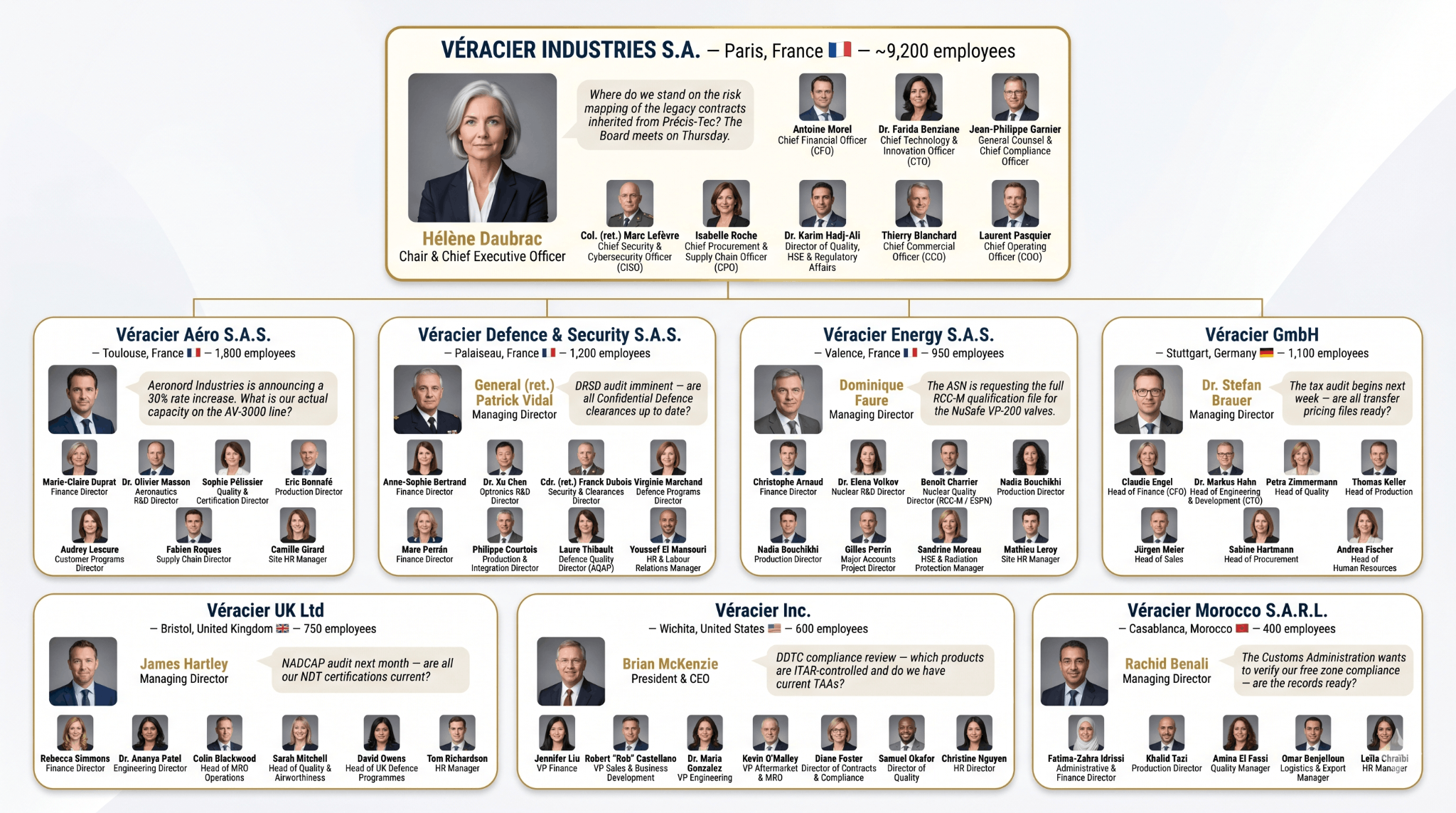
A defect appears isolated. A corrective action seems resolved. A quarterly audit is approved. Taken separately, nothing triggers an alert. Taken together, these elements reveal the trajectory of a supplier whose performance is deteriorating.
Karim opens LightOn and asks the question exactly as he would ask his quality team:
“Over the past 24 months, which suppliers show a negative trend? Analyze NCRs, CAPAs, and audit results.”
The Trend the Dashboards Never Revealed
A few minutes later, LightOn responds. Across all suppliers analyzed, only one shows a negative trend: Forges Martellière. The very supplier procurement wants to scale up.
The analysis reconstructs what no report had ever brought to light: the evolution of each supplier between January 2023 and March 2025.
Forges Martellière S.A.: negative trend
28 nonconformities, representing 25% of the group’s total. Twelve recorded in 2024, compared with eight in 2023 — a 50% year-over-year increase. All share the same common factor: dimensional defects on forged TA6V titanium parts. Yet dimensional defects are the group’s leading failure mode, accounting for 37% of all nonconformities. Over the same period, group-wide nonconformities increased by 12%. Forges Martellière’s deterioration is therefore outpacing the average. Precisely the supplier procurement wants to expand.
Baltic Composites OÜ: stable, but a new signal is emerging
10 nonconformities, representing 9% of the total. Volume remains stable. A new type of defect has appeared: fiber orientation. Two nonconformities in the first quarter of 2025, compared with none in 2023. Not a crisis. A signal to monitor.
SudElec Maroc S.A.: improving
Nonconformities down 20% in the first quarter of 2025 compared with the same period in 2024. Corrective actions are producing the expected results.
Rhein-Metall Präzision GmbH and Shanghai Xinhua Machining
Stable situation, or insufficient history to identify a meaningful trend.
But LightOn did not simply count defects. The platform traced each one through to its consequences.
For Forges Martellière, the corrective action plan is real. Enhanced monitoring, additional audits, reinforced incoming inspections, qualification of an alternative supplier. It is also still ongoing. It runs until March 15, 2028.
An active corrective plan is not a completed corrective plan. The twelve nonconformities recorded in 2024 all relate to the same dimensional defect, even though corrective actions were already in place. Until the plan reaches its end date, there is no proof that it has stopped the defect from recurring. This is exactly what a list of closed CAPAs conceals. A corrective action marked as closed describes an administrative task that has been completed. It does not say that the defect has stopped reappearing.
Every conclusion is linked back to its sources, all the way to the trend analysis document covering the full twenty-four months: nonconformity registers, individual reports, CAPA files, and audit reports.
When the supplier review begins, procurement continues to defend the doubling of volumes. The dashboard says “qualified.” The list of closed CAPAs suggests that everything has been addressed. Then Karim displays the consolidated 24-month trend. The conversation changes immediately.
The question is no longer: “Is this supplier qualified?”
It becomes: “Are we about to double our exposure to the supplier whose performance is deteriorating the most, before we even have enough hindsight to know whether the corrective actions will actually deliver results?”
Where Traditional RAG Systems Reach Their Limits
This result is not difficult because the information is hidden. Every nonconformity is recorded. Every CAPA is documented. Every audit is archived.
The difficulty lies elsewhere: the answer does not exist in any single document. It lies in the relationships between fourteen different documents.
A traditional search system can retrieve a nonconformity report, a corrective action, or an audit report. It cannot:
- aggregate nonconformities by supplier when they are scattered across registers, detailed reports, and emails;
- reason over time to distinguish a supplier that is deteriorating from one that is recovering;
- link each nonconformity to its corrective action, then each corrective action to its follow-up audit, supplier by supplier.
Finding the documents was never the problem. Understanding the trajectory they collectively describe is the real challenge.
Why This Use Case Matters
EDiTh’s QUAL-02 scenario does not test the ability to retrieve a nonconformity report. It tests the ability to reason over two years of quality data, distinguish a deteriorating supplier from a recovering one, and then substantiate that conclusion using the corrective actions and audits that have, or have not, produced the expected results.
The challenge is not finding a PDF that mentions a defect. It is measured in front of the people Karim will have to answer to.
- In front of a procurement committee that wants to double volumes, you need a documented reason to slow down.
- In front of a customer auditor, you need to justify the evaluation of each supplier, line by line.
- In front of an EASA inspection, you need to prove that dimensional defects on forged titanium parts have been tracked through to resolution, or flag that they have not.
A list extracted from a dashboard does not hold up in those three rooms. A consolidated, sourced, and explainable assessment does.
Test the Scenario Yourself
The QUAL-02 scenario is part of EDiTh, LightOn’s open enterprise benchmark built around Véracier Industries.
Ask the same question:
“Over the past 24 months, which suppliers show a negative trend? Analyze NCRs, CAPAs, and audit results.”
Then see whether your system merely retrieves nonconformity reports, or whether it can truly identify the supplier whose evaluation you will need to justify in front of a customer auditor.
Start with EDiTh. Then Test It on Your Own Documents.
Download the Véracier Industries dataset.
Access LightOn Console to run the scenario yourself.
Test it on EDiTh in Console. Then deploy it on your own documents, on your own infrastructure: open models, auditable pipeline, and no data leaving your perimeter.
Want to understand how the corpus was built, how document retrieval was implemented, and why this answer is so difficult to produce? Read the EDiTh launch article.

.png)
.avif)
.avif)