.svg)

TL;DR
A case study on M&A due diligence: LightOn inventories every non-compete clause across an international workforce, then does what a search system cannot do. It tells you which clauses would hold up in court, which are void by law, and which have already been waived.
6:55 AM. Nathalie Verdier is reading the acquirer's data-room request list before the office is even awake.
One line stops her:
"Provide a complete inventory of non-compete clauses across the group: covered employees, durations, and jurisdictional enforceability. Required for valuation."
At first glance, the task seems straightforward:
- Find the contracts that contain a non-compete clause
- List who is covered and for how long
- Hand it over
But in a group like Véracier, the existence of a clause and the enforceability of a clause are two completely different questions. A buyer is not paying for clauses on paper. They are paying for the ones a court would uphold.
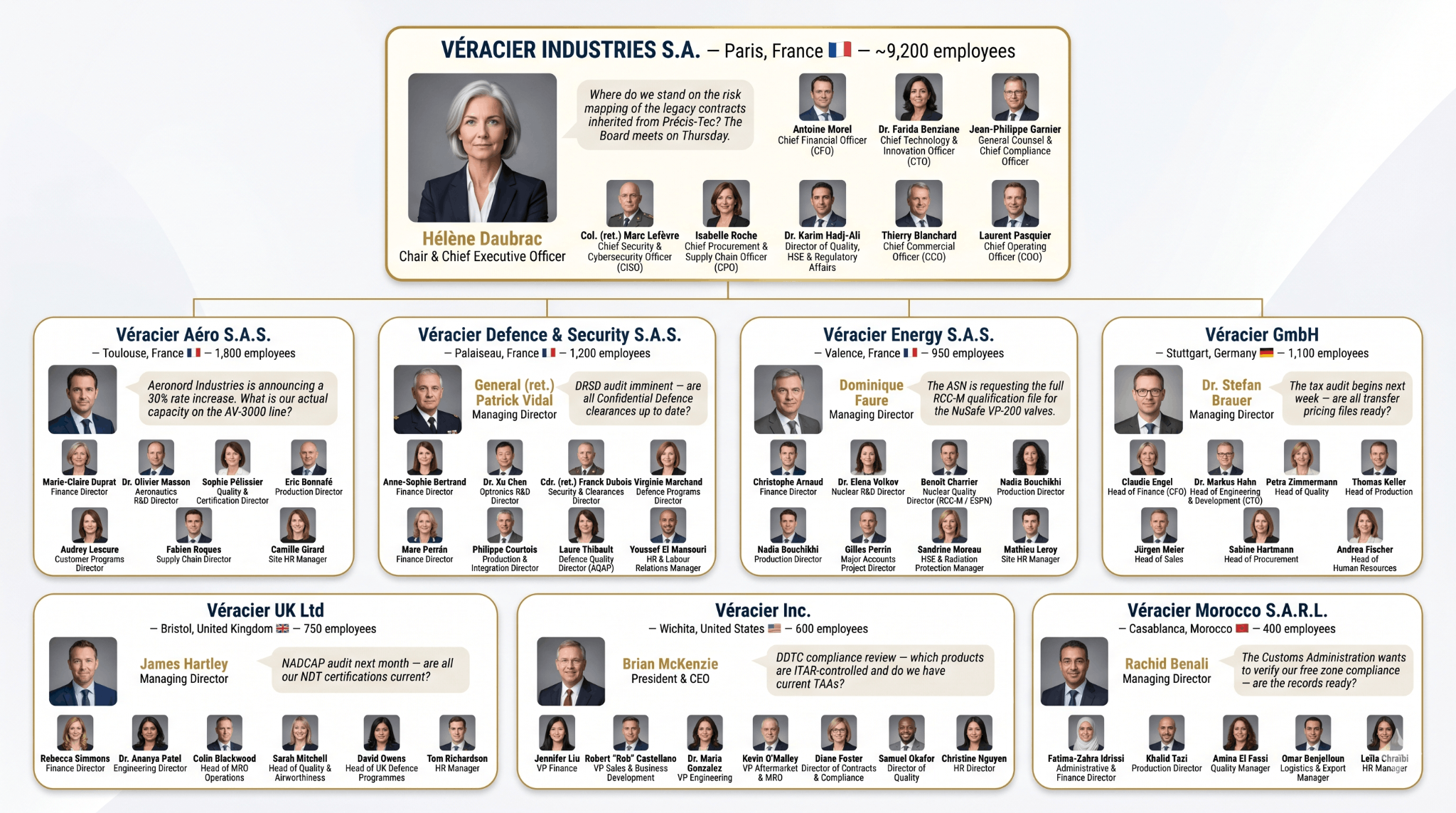
A French contract carries a clear 24-month clause. A German template looks identical, but says nothing about compensation. A California contract spells out a non-compete clause in careful detail. One employee's clause was quietly waived a year ago, in an amendment buried inside a scanned batch.
Read in isolation, every clause looks valid. Read against the law that governs it, the inventory falls apart.
Nathalie opens LightOn and asks the question exactly as she would ask her legal team:
"Which employees are subject to a non-compete clause? For what durations? With what enforceability across jurisdictions?"
The inventory that survives legal scrutiny
A few minutes later, LightOn returns not a list of clauses, but a map of which ones actually bind.
Who is covered. Employees with access to sensitive information: management and senior executives, R&D, sales, and purchasing staff. The clause applies within Véracier Industries S.A. and Véracier Défense & Sécurité S.A.S.
For how long. 24 months for senior executives, 12 months for other managers. Territory: the European Union and Switzerland.
Where it actually holds, jurisdiction by jurisdiction.
France. Governed by the French Labor Code. Enforceable under the usual conditions.
Germany. Governed by §110 GewO. Enforceable only with compensation of at least 50% (Karenzentschädigung). The group's German template omits it, which means that, as drafted, the clause does not bind anyone.
United Kingdom. Restrictive covenants, valid only if they pass the reasonableness test.
United States. Varies by state. In California, the clause is void as a matter of law under BPC §16600. The carefully drafted California contract is unenforceable, regardless of its wording.
Morocco. Governed by Article 109 of the Moroccan Labor Code.
And one clause that no longer exists. The company reserves the right to waive a non-compete clause within one month of a termination notice. One employee's clause had already been waived: the Dumont amendment of February 2024, recorded in a scanned batch and absent from every clause summary.
Every conclusion links back to its source: individual employment contracts, jurisdiction-specific templates, scanned amendment batches, and the applicable labor-law texts.
The inventory requested by the acquirer and the inventory that would survive its lawyers are not the same document. The first counts clauses. The second tells you that the German and Californian clauses do not bind as drafted, and that the Dumont clause has already disappeared, before the acquirer's counsel finds it first.
Where traditional RAG loses the thread
This result is not hard because the clauses are hidden. Most of them sit in standard contracts. It is hard because a non-compete clause means nothing until it is read against the law that governs it, and that law changes at every border.
A conventional search system can retrieve a contract that contains a non-compete clause. It can even retrieve all of them. What it cannot do is:
- Apply the law of each jurisdiction to each clause, recognizing that a valid-looking California clause is void under BPC §16600 and that a German clause without Karenzentschädigung is unenforceable
- Decompose scanned batches contract by contract, so a clause buried inside a multi-document PDF is treated as its own record rather than lost in the pile
- Detect a waiver, by linking the original clause to the later amendment that cancelled it, the Dumont case being exactly the kind of fact that quietly breaks an inventory
A clause that exists is not a clause that binds. Search stops at "this contract contains a non-compete clause." Due diligence begins at "and here is what it is actually worth."
That is the moment the use case becomes impossible for a search system. Finding the clauses was never the hard part. Knowing which ones a court would throw out was.
Why this use case matters
The HR-01 scenario in EDiTh was not designed to test whether a system can retrieve an employment contract.
It tests something far harder: reasoning over an international workforce to separate the non-compete clauses that bind from the ones that are void, unenforceable, or already waived, and justifying every verdict with the text that governs it.
The challenge is not surfacing a PDF that contains a non-compete clause. It is producing the inventory you would hand to an acquirer's legal team, knowing they will test every clause you claim is enforceable.
Test the scenario with EDiTh
The HR-01 scenario is part of EDiTh, LightOn's open enterprise benchmark built around Véracier Industries.
Download the Véracier Industries dataset, then test the scenario with your internal tools.
Ask the same question:
"Which employees are subject to a non-compete clause? For what durations? With what enforceability across jurisdictions?"
Then observe what your system is really capable of. Does it merely retrieve employment contracts that mention non-compete clauses? Or can it identify, explain, and source which clauses actually bind across jurisdictions?
From EDiTh to your own documents
EDiTh lets you test this type of reasoning on an open, controlled, and reproducible corpus. The next step is to apply the same approach to your own documents: HR records, employment contracts, amendments, internal emails, legal templates, or business knowledge bases.
With LightOn Console, you can deploy this type of analysis on your own infrastructure, with open models, an auditable pipeline, and no data leaving your perimeter.
Want to understand how the corpus was built, how document retrieval was implemented, and why this answer is so difficult to produce? Read the EDiTh launch article.

.png)
.avif)
.avif)